
There is a difference between reducing an expense line and reducing the effort required to run a business.
Cut capacity while leaving the work unchanged, and the pressure has to go somewhere. It can show up in longer queues, more overtime, delayed customer responses, or problems that surface later in quality assurance.
My view is that a credible efficiency program has to explain what work will change. If the answer is simply that people will absorb more, the operating model has not improved.
Understand the cost of a completed outcome
Our Enterprise Process Intelligence Framework, EPIF, starts by defining the outcome and following the work needed to deliver it. In banking, that might be an account opened, a loan funded, a complaint resolved, or a customer review completed to the required standard.
The baseline should include the full path. A team may report a low processing cost while another team absorbs the corrections. A faster initial review may produce more downstream questions. Local improvements can disappear when measured across the entire process.
Measure handling time, waiting time, repeat work, exceptions, and demand. Separate necessary variation from differences that have accumulated through habit or organizational boundaries.
That gives leaders a more useful basis for action than a uniform reduction target across departments.
Change the sequence of investment
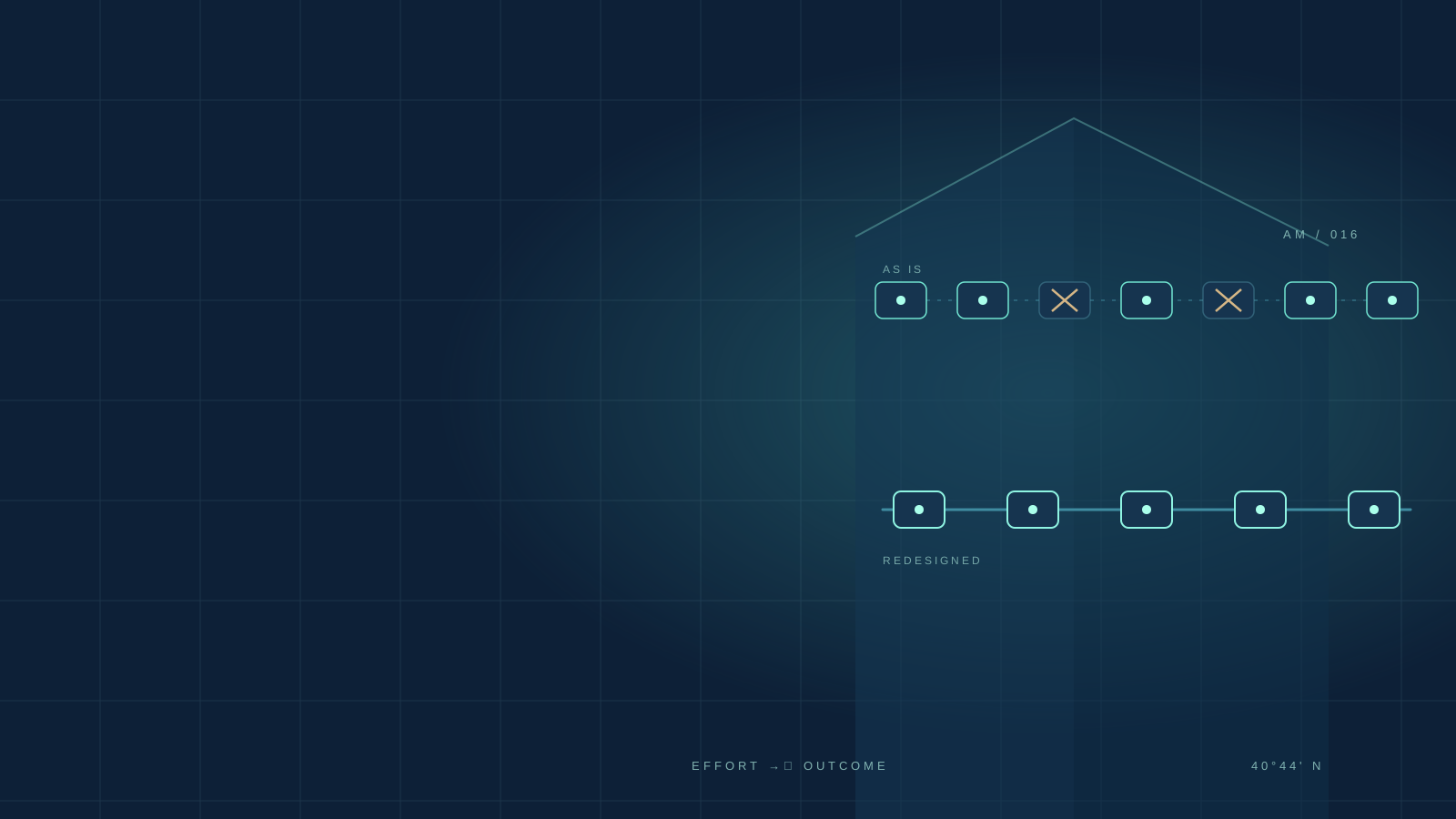
The EPIF intervention hierarchy starts with elimination, simplification, and standardization before moving to integration, automation, and AI where justified.
An approval added years ago may duplicate a control elsewhere. A report may still be produced even though nobody uses it to make a decision. Teams may interpret the same requirement differently and generate avoidable referrals.
Each case needs evidence and the right approval before changing the process. Mandatory controls must be preserved, and removing a control requires an appropriate assessment. The aim is to reduce unnecessary effort while keeping the required outcome reliable.
Once the work is clearer, technology investment becomes easier to target. Automating a stable, necessary activity has a stronger foundation than automating a process full of unresolved exceptions.
Be precise about savings
Recovered capacity, avoided future cost, and reduced spending are different benefits.
If a change frees several hours a week across a team, explain how that capacity will be used. Can the team absorb growth? Reduce contractor dependence? Clear a backlog? Improve service? Does the staffing model allow an actual expense reduction?
Finance should agree the baseline, attribution, and realization plan before delivery. Include implementation costs and any new ongoing expense. Then track cost per completed outcome alongside quality, service, and control measures, allowing for changes in volume and complexity.
The Sustain stage of EPIF gives an operating owner responsibility for keeping those gains. Without that ownership, workarounds and unnecessary steps can return.
The best cost program leaves a business easier to run. Customers experience less friction, employees spend less time correcting problems, and management can explain where the savings came from.
Where to start
Identify one expensive value stream and use EPIF to establish how much of its cost can be removed through better process design.
Related
Documented result: 30,000 hours of branch capacity restored
Documented result: 47% less compliance review time
Fix the workflow before you automate it