
Find the right
opportunity.
EPIF reveals the process constraint, the baseline, the competing interventions and the path to value.
Explore the EPIF method ↗︎ALACER MATRIX / AI STRATEGY + DELIVERY + GOVERNANCE
AI creates value when the work is understood, the technology fits and the results can be proven. We bring process intelligence, engineering and governance together to move financial institutions from possibilities to production.
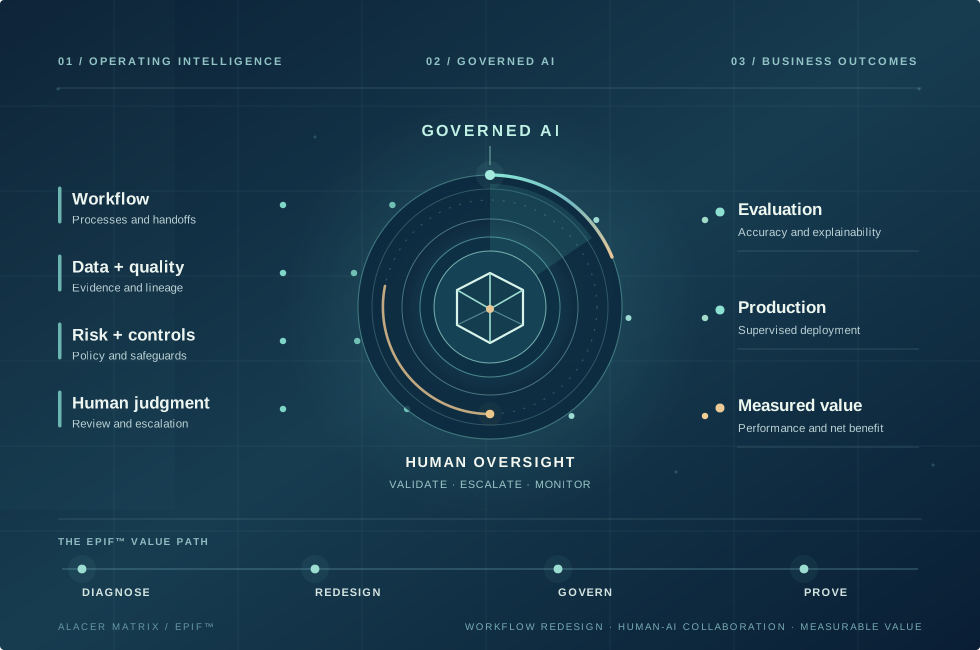
AI only creates durable value when workflow redesign, human-AI collaboration, governance and measurable outcomes are engineered together. EPIF starts with the work and makes the investment case defensible.
We connect the business case, the technology build and the control framework. That means choosing AI only where it outperforms simpler process changes, designing for regulated environments and measuring value after go-live.
ONE ACCOUNTABLE DELIVERY MODEL
Most AI programs struggle at the handoffs. Our model connects the decision to invest, the solution that ships and the evidence that makes it trustworthy.
EPIF reveals the process constraint, the baseline, the competing interventions and the path to value.
Explore the EPIF method ↗︎Design, integrate, test and operationalize GenAI, agentic workflows, analytics and automation in the real business.
See AI deployment decisions ↗︎Define accountable owners, risk-tiered approval, model oversight, evaluation, human controls and ongoing evidence.
Read our view on trusted AI ↗︎Process intelligence →︎ Data foundations →︎ Controlled build →︎ Governance →︎ Measured performance
WHAT WE DELIVER
Four connected capabilities - available independently or together - for financial institutions modernizing critical work.
Business-case discovery, use-case scoring, process mapping, data-readiness assessment and sequenced investment roadmaps.
EPIF / VALUE CASE / PRIORITIZATIONDocument intelligence, retrieval-based assistants, workflow copilots, human-supervised agents, and implementation in existing platforms.
BUILD / INTEGRATE / EVALUATE / SCALEEnterprise AI inventory, risk classification, policy and approval paths, independent challenge, monitoring and audit-ready evidence.
OVERSIGHT / CONTROL / ASSURANCEData quality, lineage, secure access, architecture and integrations - with training, change management and ongoing operational support.
DATA / SECURITY / CHANGE / OPERATEThese capabilities draw on Alacer Matrix's financial-services expertise and the wider Matrix group's data, engineering and AI delivery experience. Explore Matrix's AI capabilities ↗︎
WHERE AI MEETS THE OPERATION
Examples of opportunities we can assess and design. These are illustrative - not claims that the AI solutions shown have been deployed for named clients.
KYC / EDD
Repeated searches, fragmented client data, document chasing and QA rework.
Source-grounded evidence packs and case drafting, reviewed by trained investigators.
Approved data boundaries, citation accuracy, exceptions, human sign-off and fallback.
Review time, rework, quality, cost per completed case and net savings.
SAFE BY DESIGN / ACCOUNTABLE IN PRACTICE
In a regulated institution, controls should not be an afterthought. We bring AI policy, model risk, security and operational ownership into the same decision path as design and implementation.
Explore AI governance and model risk ↗︎Inventory internally developed, purchased, embedded and agentic use cases.
Tier by sensitivity, decision impact and autonomy, with named approval authority.
Test outputs, source fidelity, privacy, failure behavior and security boundaries.
Set escalation, override, stop controls and operational accountability.
Track change, drift, incidents, adoption, costs and measurable outcomes.
COMMON QUESTIONS
The questions we are asked before an AI conversation turns into a program.
With the work, not the model. Establish what a process actually costs and what is causing it, then work through the intervention levels in order: eliminate, simplify, standardize, integrate, automate, and only then AI. Most recoverable value sits before the technology, and an AI use case built on a stable, measured process is the one that survives validation and an examiner.
Through the EPIF AI Value and Readiness Assessment, which produces four things: a workflow evidence pack showing where time and cost actually go, a ranked intervention plan, a deployment control outline, and a Finance-ready measurement plan. It ends in a defendable go, redesign or no-go decision rather than a pilot that drifts.
Four disciplines applied before go-live and sustained after it: know every AI use in the institution and classify its risk; test against real failure modes with independent challenge proportional to that risk; keep human authority explicit, with review, override, escalation and stop rights; and make controls visible in production through monitoring, audit trails and trigger-based revalidation. For banks this is aligned to supervisory expectations and the NIST AI Risk Management Framework.
Yes. In transaction monitoring validation at an international bank, data scientists tuned scenarios and thresholds and cut unproductive alerts by 67%. In an AML investigation function, assisted investigators cleared an aged review backlog with the control perimeter agreed before any tooling was introduced. Both are documented in Client Results with their original sources.
All three, under one accountable team: advisory to decide what to change and in what order, engineering and process design to build it, and specialist delivery to keep critical operations moving while it is implemented. The same method, EPIF, runs through each.
THE FIRST STEP
Start with an AI value and readiness conversation. We'll help define the business decision, compare options and determine which evidence is needed before a major investment.