
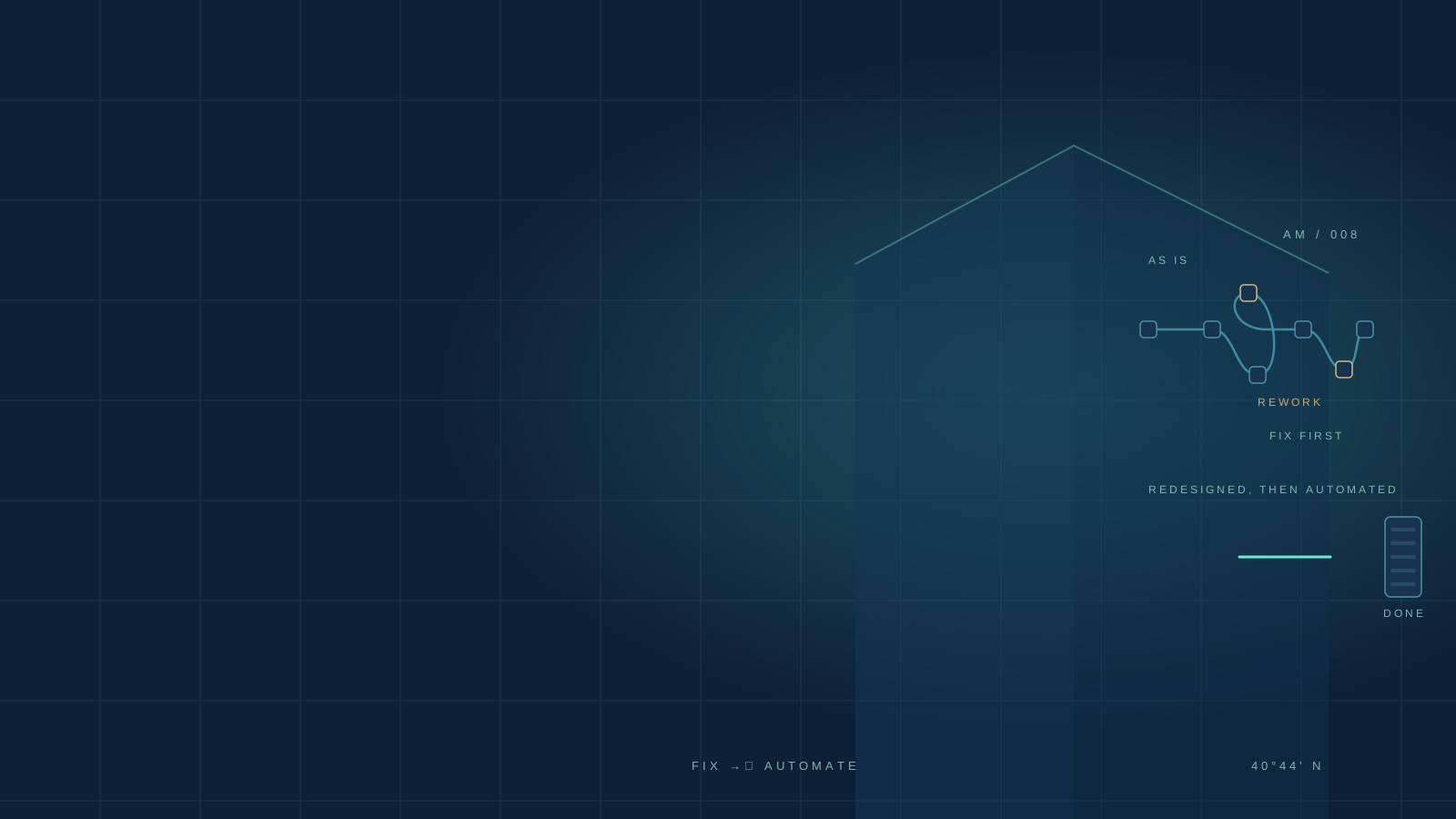
Automating a workflow before it has been fixed does not remove its problems; it makes them run faster, at scale, with a system's authority behind them. The order of operations is the whole discipline: understand the work, simplify it, then decide what deserves technology.

See the process as it really runs
Policies and procedure documents describe how work is supposed to happen. Actual work is different in ways that matter: handoffs that exist because two teams never agreed who owned a step, exceptions that have quietly become the main path, waiting time that dwarfs touch time, data entered twice because two systems do not talk, and workarounds that experienced staff carry in their heads. None of this appears in the process map an automation vendor is handed, which is why so many automations faithfully reproduce the documented process and then collide with the real one.
The remedy is to observe and measure the flow as it actually runs before a future state is drawn: follow a sample of cases end to end, time each step and each wait, count the rework loops, and ask the people doing the work where it hurts. In a compliance review function at a large North American bank, that exercise alone, before any tool was selected, showed where 47% of review time was going to steps that added nothing to the control.
Simplify, then digitize
Once the real flow is visible, most of the value is in subtraction. Remove the steps that exist only because of an earlier handoff. Make one person accountable for each decision rather than three people partly responsible. Define what a complete, correct input looks like so that quality is checked once, at the point it can be fixed cheaply, rather than discovered at the end. Only when the process is simpler and stable does the question of technology become answerable, because now there is something worth automating and a baseline against which the automation can be judged.
This is also the step that protects the business case. Automation priced against a bloated process looks compelling and then disappoints, because the waste it was going to eliminate was removable for free. Automation priced against a simplified process is smaller, cheaper and far more likely to deliver what was promised. The Currency Transaction Reporting team that filed 40% faster did so with Kaizen and no new system at all; the technology conversation that followed started from a much better place.
Connect business and technology
A redesigned workflow that is handed over the wall to a delivery team arrives as a set of ambiguities. The way to prevent that is to produce, as part of the redesign, the things a delivery team actually needs: requirements written as decisions the system must make and the data each decision depends on; data contracts that say which system is the source of truth for each field; explicit control points, with the human review and escalation paths that regulators will expect to see; and a named owner for the implementation who is also accountable for the outcome. Integrated teams, where the people who understand the process and the people who build the technology sit together, are the practical way to make this routine rather than heroic.
Track outcomes, not activity
Go-live is the beginning of the value story, not its conclusion. The measures that tell you whether the change worked are outcome measures: customer impact, end-to-end cycle time, first-time-right quality, control effectiveness, cost per completed unit of work, and operational resilience when volume spikes or a system fails. Counting automated transactions is activity; it says nothing about whether the work is better. Agree the baseline before the change, with Finance in the room, and report against it afterward in the same units. That is the only version of "we saved X" that survives an audit.
Done in this order, automation stops being a bet on a tool and becomes the last step of a process that has already been improved. That is the sequence EPIF formalizes: find the recoverable value on evidence, fix the lowest-risk things first, and automate only where the economics still hold once the process is clean.
Case: 47% less compliance review time, found before any tooling
Case: 40% faster CTR filings with Kaizen and no new system
Technology and process: how we design both together
How EPIF sequences the decision
Sources: Alacer case studies, Compliance at Large North America Bank Gets Lean and Kaizen Reduces Waste in Currency Transaction Reporting Processes; figures as reported at the time of each engagement.